
The design world has seen some significant changes over the last decade but none has been as controversial and change making as AI. When I started graphic design 25 years ago, there was one dominate player: Adobe. If you wanted to design a poster or a book or a logo, you needed Adobe Photoshop, InDesign or Illustrator. They had a strangle firm hold on design software until about 10 years ago when Canva & Affinity arrived. Canva is accessible with a free/low cost entry point and its tools have a low learning curve. Affinity has the same features as Adobe products but at a much lower cost. Canva since bought Affinity and made it free (RIP Adobe).
Now game is changing again. Canva has integrated AI tools into its software and AI has image generation. This new technology may appear on the surface as even more accessible, with an even smaller learning curve, but AI is still a long distance away from being able to design a great brand for you. The file it generates won’t work in some situations like trade show displays or embroidery. The style makes your business stand out in a bad way, and then there are the legal, environmental, & ethical issues.
My advice as a seasoned designer is to wait on AI for now. Give the technology and the market time to catch up before creating something that won’t serve you well in the long run.
AI logos won’t work in common situations
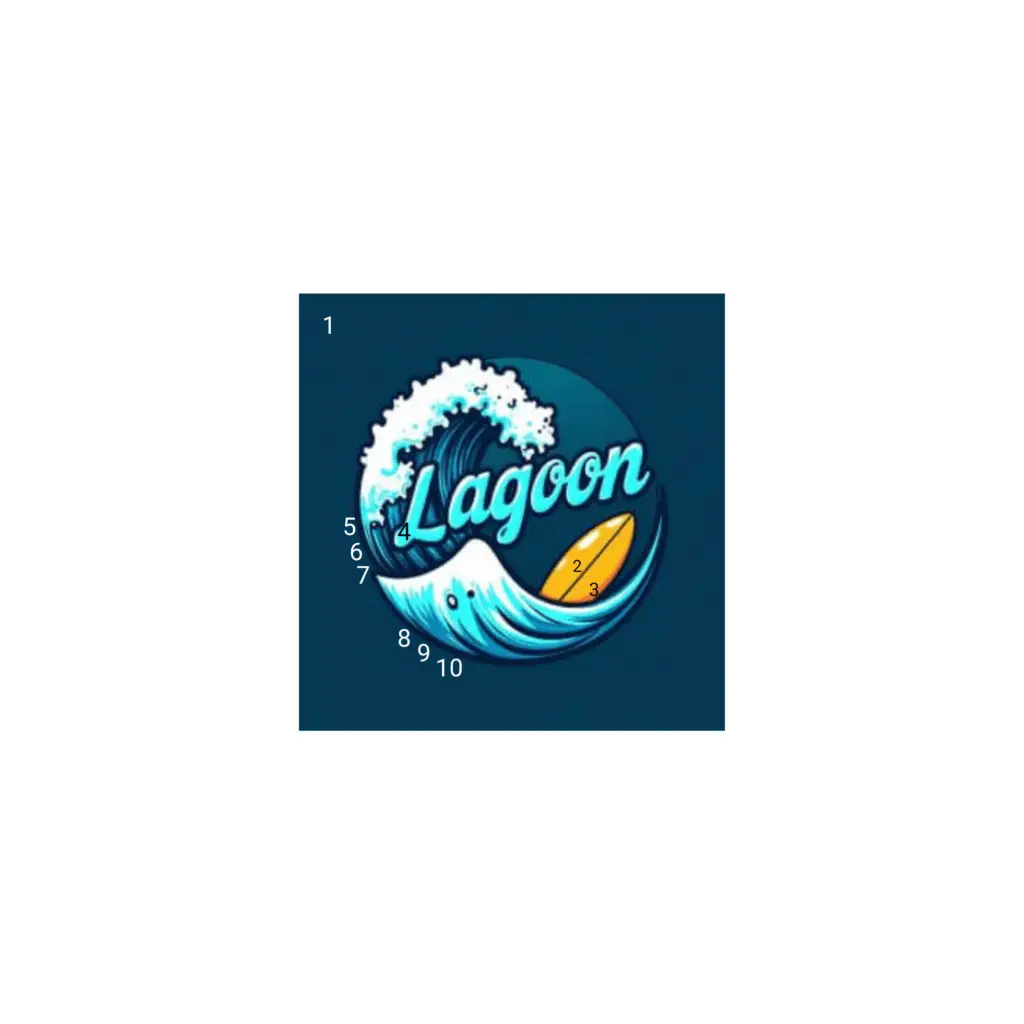
Colours: Best practice in logo design is to define a palette of 3-5 brand colours that appear in the logo. These colours are then deployed throughout the brand assets (website, social media, business cards, product labels) consistently. That consistency, where customers see your unique combination of colour/font/shape/style over and over is what gains you customer trust.
AI logos often contain many colours, gradients, and shading that pose a problems with deployment digitally and physically. Designing things like social media posts with 3-5 colours is straight forward. Designing things with a palette of 24 colours is much harder. A large colour palette also poses problems when you want to make SWAG. Any company that deals with colours as individual layers like screen printers (t-shirts), embroidery (hats, shirts), and even in some printing scenarios (off set printing) charge by the colour and if you have 24 colours, it’s going to get super expensive or impossible to replicate your logo.
Fonts: I’ve also noticed that many AI generated logos aren’t choosing fonts and adding text, they are drawing letters instead. This is problematic when you try to use the same font on your website or product label. You’ll spend too much time trying to match to a font that doesn’t exist.
Font psychology is also a large part of branding design that AI generated logos seem to skip, instead it draws letters that looks like bland sans-serif fonts that don’t communicate much, a missed opportunity.
Resolution/File type: The file that AI provides when generating a logo is a PNG. This might be ok for digital applications like a social post but it has a limit on how big you can make it before it starts to look pixelated or distorted. You may not be in the market for a billboard but you might be in the market for a trade show display. And if you are trying to create a fun give away (like a pen or water bottle) for your booth, you’ll need a SVG (vector file)— which AI can’t generate (yet). A PNG file also can’t be edited. Sure you can open up Photoshop Affinity and change the colour of something but there are no layers or curves which severely limits the changes you can make.
Black and white versions: AI generates logos that have many colours and these designs aren’t adaptable into an all black or all white version. Why does this matter? There are many times where having your logo in all black or white comes in handy like the top of your receipt, co-branding, and photo watermarks.
AI logos stand out in the wrong way
AI = new Comic Sans: The running joke amongst designers was that if a company was using Comic Sans as a font, it was a public cry for design help. Right now seeing an AI generated logo is giving the same vibes.
AI logos are easily identifiable, it’s all the same visual pop-y, in your face style. It has exaggerated illustrations of many common objects that are literally connected to the company name (like multiple hammers for a construction company) with many shadows, gradients, and overlapping elements. This style is trendy and will fade in a few years. Timeless design is well, designed. It is balanced, free of unnecessary elements, unique, and can even use negative space to communicate well. AI can’t do any of that right now.
There is a growing divide between people who think AI logos are fun and easy and those who think they make the companies look lazy and low-quality.
AI logos have environmental, ethical, and exclusivity issues
Environmental: AI is thirsty. “AI’s projected water usage could hit 6.6 billion m³ by 2027” (Forbes, 2026). That’s 2.64 million Olympic-sized swimming pools! Technology companies are building more, bigger data centres that need cooling for AI. Some estimates say AI servers can consume the equivalent to one 500ml bottle of water for every 20-50 prompts. When 1.1 billion people on earth lack access to clean water, diverting water to data centres becomes concerning.
Ethical: AI logos aren’t drawn or designed, they are assembled. AI doesn’t have any actual creativity or original thoughts, it generates each pixel based on an algorithm. The algorithm looks at its knowledge base and lines up the pixels based on your prompt. The main ethical problem is that AI has created that knowledge base from billions of images it scraped from the internet for free. Is it plagiarism if the final product is an assembly of twelve different elements from twelve different original designs? One hundred? Three?
Traditionally, companies pay a designer a fee to design something that will help them make money. AI is charging for image generation but it didn’t pay for the art it learned from, leaving designers out of the loop. The dozens or even hundreds of hours a designer spent creating those logos, posters, and social posts has been dumped into this knowledge base without compensation to the original designers and artists.
Exclusivity: There hasn’t been a challenge to this in a court of law, yet. Canva has a trademark policy that says “Registering your logo as a trademark… that means you have the exclusive right to use that mark to distinguish your goods and services from other businesses.” (Canva article, 2026) And “Canva’s logo templates are customizable and can be used by anyone. This means that your rights to the logo are non-exclusive and you can’t register it as a trademark.” This is probably fine for small businesses who are operating in a small geographic area or their little corner of the internet but if you want to put your product on the shelves of a national grocery store or sell internationally, you may feel the need to protect your company. You can’t do that if you created it in Canva and you can’t do that with AI either.
Canadian copyright is: “the exclusive, automatic legal right granted to creators of original literary, artistic, dramatic, or musical works—including software—to produce, reproduce, perform, or publish their work” (Government of Canada: Intellectual Property, 2026) The key word here is original. Is an AI generated logo original? I refer you back up the page to the ethical section where I state that AI images are assembled from an algorithm, not designed.
All of these questions are new, complex, and essential to be considered when designing a logo using AI.
What to do instead right now
I’ll admit my own bias here as someone who gets paid to design logos, but if you have the resources, hire a professional designer to create your branding. You can make sure that you have all the files you need for any situation and skirt the troublesome issues surrounding AI.
If you have less resources, join the Make It Club. I run Make Your Branding sprints, a done-with-you service that bridges the gap between higher end done-for-you design and unsupported courses/AI slop.
Author’s note: AI was not used in anyway in this post, this is 100% my own thoughts and pain staking research and editing.